
As Australia accelerates its energy transition, nuclear power keeps re-entering the public debate. Supporters point to its ability to deliver firm, low-emissions electricity. Critics highlight cost, timeframes, and risk — particularly in a country with some of the world's best renewable resources.
So where does nuclear actually fit in Australia's energy future?
Let's look at the evidence.
Australia's energy mix today (2025 snapshot)
Australia generates roughly 280–285 TWh of electricity per year, and the mix is shifting quickly. Based on the most recent 2025 data from AEMO, CER, and industry reporting, the national electricity mix is now approximately:
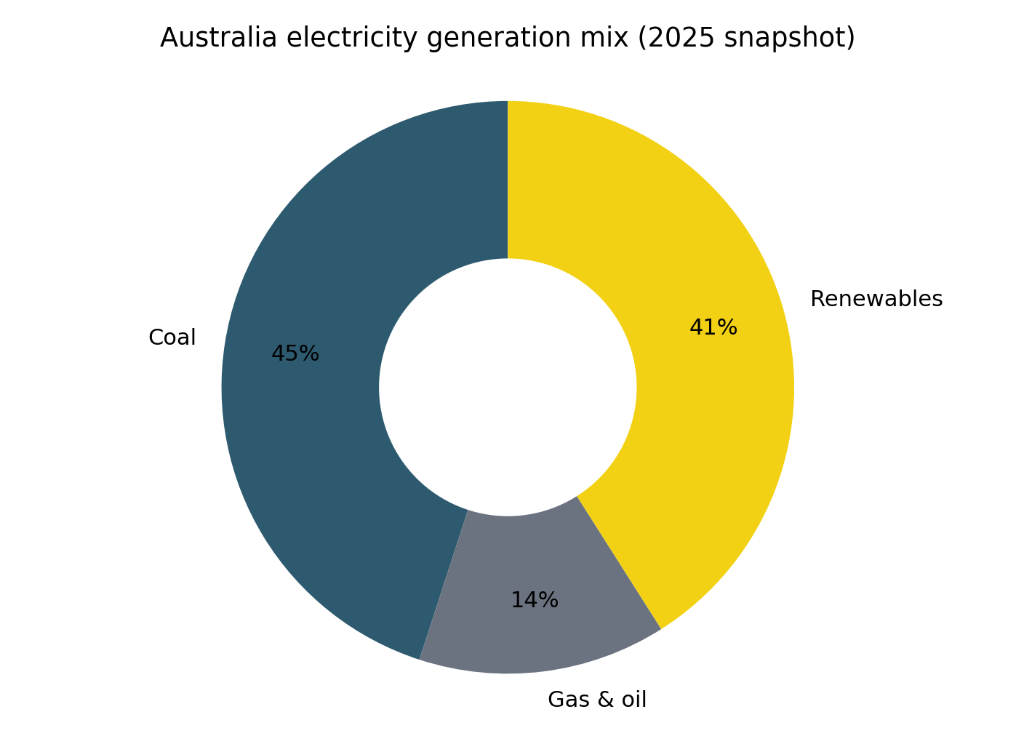
Renewables now regularly supply over 40% of Australia's electricity, with some states — particularly South Australia — frequently operating at near-100% renewable generation during certain periods.
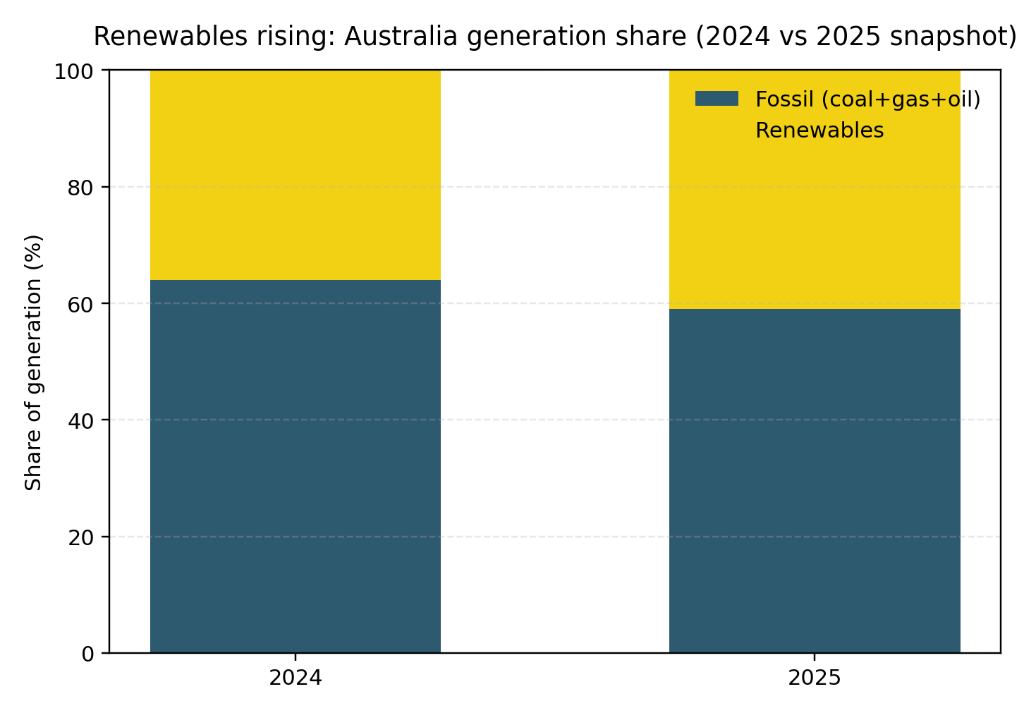
At the same time, electricity demand is forecast to nearly double by 2050 as transport, heating, and industry electrify. This creates a dual challenge:
- Replacing ageing coal generators
- Supplying much more electricity — reliably and affordably
Why nuclear power appeals to some
There are legitimate reasons nuclear remains part of the conversation.
Firm, low-emissions electricity
Nuclear plants operate at very high capacity factors and produce electricity with extremely low operational emissions. In theory, they can replace coal generation without relying on weather conditions.
Energy density
A single nuclear plant can generate large amounts of electricity from a small physical footprint, compared with wind and solar which require more land and transmission infrastructure.
Grid stability
Traditional nuclear generators inherently provide inertia and system strength — services historically supplied by coal and gas plants.
From a technical perspective, nuclear works.
The harder questions: cost, timing, and risk
Where nuclear struggles in Australia is not physics — it's economics and delivery.
Cost: nuclear is expensive to build
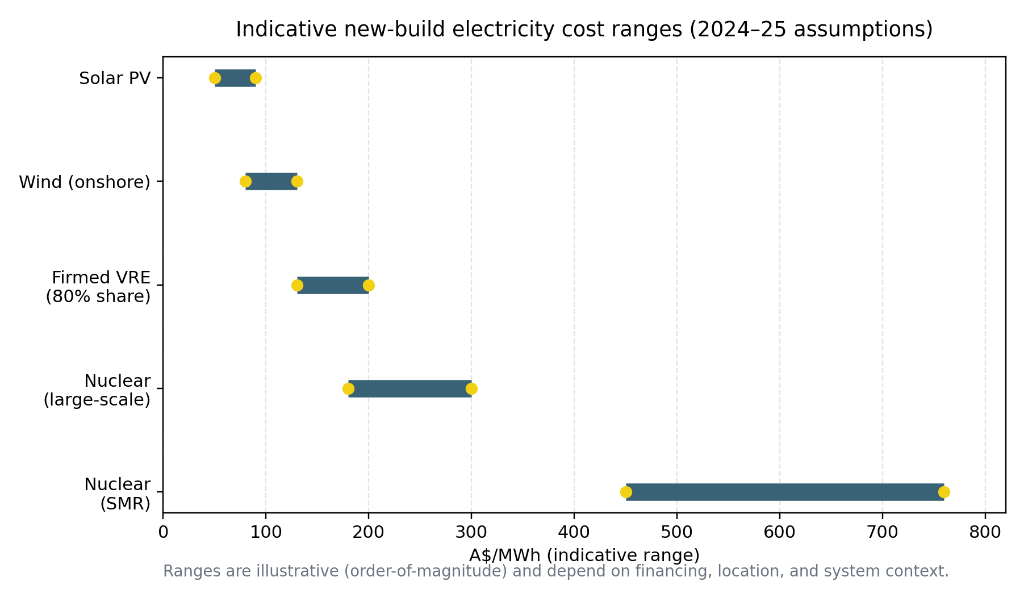
Independent Australian modelling (CSIRO/AEMO GenCost) consistently shows:
- Solar and wind are the cheapest new sources of electricity
- Firmed renewables (renewables + storage + transmission) cost less than nuclear
- Nuclear — especially SMRs — sits at the high end of cost estimates
The challenge isn't fuel cost; it's capital intensity, financing risk, and construction complexity.
First-of-a-kind nuclear projects in countries without an existing nuclear industry are particularly exposed to cost overruns and delays — a risk Australia would face squarely.
Timing: nuclear arrives too late for the real problem
Australia's coal fleet is retiring this decade. Nuclear projects typically require 15–20+ years from
Australia currently:
- Prohibits nuclear power under federal law
- Has no commercial nuclear regulator
- Has no operating nuclear construction workforce or supply chain
Even under optimistic assumptions, nuclear cannot arrive in time to replace retiring coal generation.
Australia's unfair advantage: cheap renewables at scale
This is the key context often missed in nuclear debates.
Australia has:
- World-class solar resources
- Strong onshore wind
- Abundant land
- Rapidly falling battery and inverter costs
- Proven ability to deploy renewables quickly
From a system-planning perspective, the lowest-risk path is usually to lean into what you're best at. For Australia, that is renewables — not capital-intensive nuclear construction.
This is why AEMO's Integrated System Plan consistently identifies renewables, storage, transmission, and flexible demand, backed by limited gas, as the least-cost pathway to a reliable net-zero grid.
So… should Australia invest in nuclear?
The clear answer
Nuclear power is not the most sensible primary investment for Australia today.
Not because nuclear is inherently flawed — but because:
- It is too slow to address coal retirements
- It is more expensive than available alternatives
- It carries higher financial and delivery risk
- It diverts attention from solutions already working at scale
When could nuclear make sense?
Nuclear could become more relevant if:
- Renewable rollout or transmission build-out stalls significantly
- Long-duration storage fails to mature
- Electricity demand grows far faster than expected
- Nuclear costs fall substantially and Australia commits to a multi-unit program
Even then, nuclear would likely play a supporting role, not a dominant one.
Final thoughts
Australia's energy transition is not limited by technology — it is limited by execution.
The fastest, cheapest, and lowest-risk path forward is to:
- Accelerate renewables
- Invest in storage and grid flexibility
- Electrify demand intelligently
- Use gas as a declining backup, not a long-term solution
Nuclear power may remain part of a future discussion. But for Australia — with abundant space, cheap renewables, and urgent decarbonisation needs — it is not the silver bullet, and not the best first move.
References & Sources
- Australian Energy Market Operator (AEMO), Integrated System Plan (ISP) 2024. https://www.aemo.com.au/energy-systems/major-publications/integrated-system-plan-isp
- CSIRO & Australian Energy Market Operator (AEMO), GenCost 2024–25 Final Report. https://www.csiro.au/en/research/technology-space/energy/electricity-transition/gencost
- Clean Energy Regulator (CER), Quarterly Carbon Market Reports 2024–2025. https://cer.gov.au/markets/reports-and-data/quarterly-carbon-market-reports
- Australian Government – Department of Climate Change, Energy, the Environment and Water (DCCEEW), Australian Energy Statistics and Australian Energy Update 2024–2025. https://www.energy.gov.au/energy-data/australian-energy-statistics
- Australian Energy Market Operator (AEMO), Quarterly Energy Dynamics (QED). https://aemo.com.au/energy-systems/electricity/national-electricity-market-nem/nem-events-and-reports/market-notices-and-reports/quarterly-energy-dynamics-qed
- Low Carbon Power, Australia electricity generation mix. https://lowcarbonpower.org/region/Australia
- Australian Government, Environment Protection and Biodiversity Conservation Act 1999. https://www.legislation.gov.au/C2004A00485
- Australian Government, Australian Radiation Protection and Nuclear Safety Act 1998. https://www.legislation.gov.au/C2004A00689